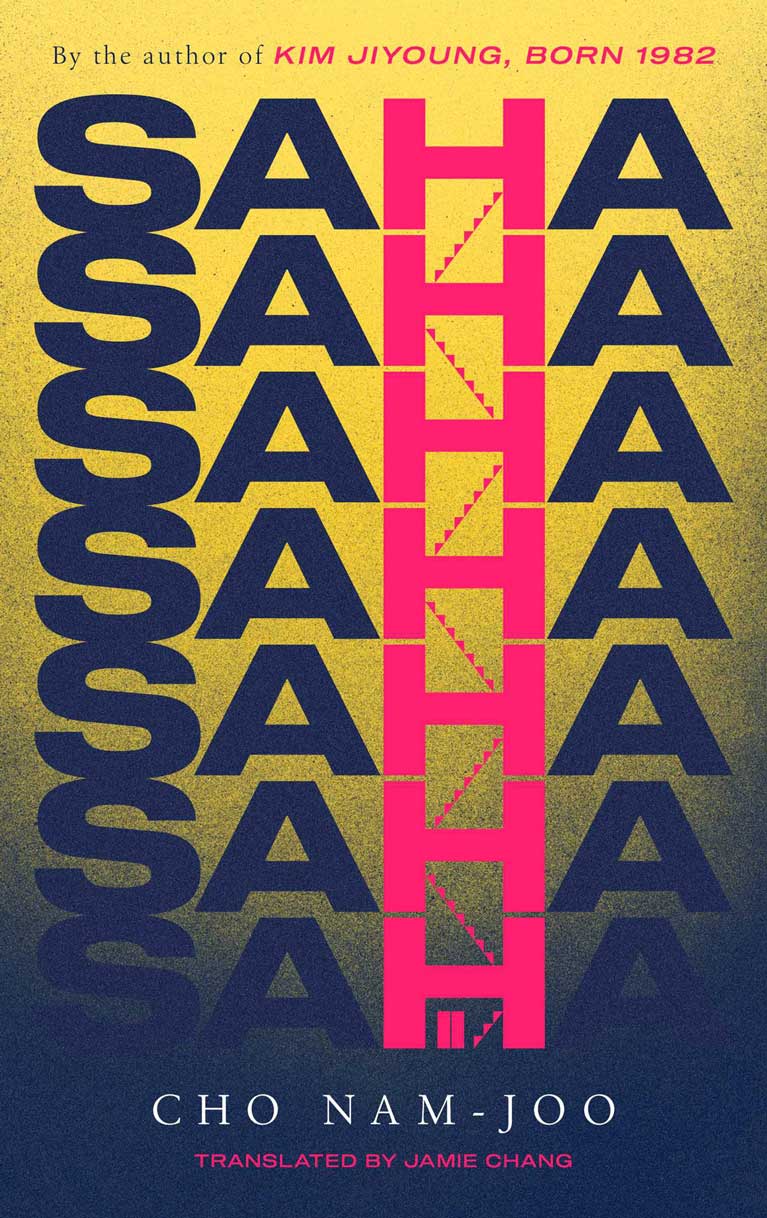
 After the domestic success of Kim Ji-young (2016; English translation by Jamie Chang published in 2020), and of its encouraging sales overseas, it was natural that Cho Nam-joo’s next novel would attract interest. Accordingly, Saha had a slightly shorter journey from Korean into English: after an original publication date in 2019 its English translation came out in 2022, again courtesy of Jamie Chang and Scribner.
Press for Kim Ji-young described it as “A howl of anger” (Sunday Times) and “A ground-breaking work of feminist fiction” (Stylist) – and it is a certainly an important work (LKL review here). In Saha she moves from the oppression of women by the male patriarchy to the oppression of the economically disadvantaged by a corporatist state.
The story is set in Town, a hyper-capitalist society situated on an island a few hours by boat from from the mainland. In this society the full citizens have all the wealth and privileges, but they rely on an underclass of level 2 non-citizen workers and an even lower stratum of barely-tolerated migrants who live in a decaying apartment complex called Saha Estates.
With the scenario of a corporatist nation-state, readers are inevitably tempted to draw comparisons with Bae Myung-hoon’s wildly quirky and inventive Tower (LKL review here). But Saha is much darker. We spend our time with the residents of the Saha Estates, a caring bunch of people who are struggling to exist on the margins of society. As the novel opens, one of their number regains consciousness in a car beside his dead girlfriend who is higher up the social scale. Murder is suspected, and the boyfriend is assumed to be the culprit. Expectations are set for a tense cat and mouse whodunnit / whydunnit, perhaps along the lines of Jeong You-Jeong’s A Good Son (LKL review here); but the author is not interested in such narratives. Although we do find out the who and the why, Cho is more concerned with exploring the injustices in a society governed by anonymous, faceless bureaucrats where no-one seems accountable for arbitrary and ruthless decisions, and in the sinister and casual exploitation of the have-nots by those in power.
Yonhwa was fired again from a kitchen job at a general hospital … The reason was that she lived in the Saha Estates – but L2s weren’t qualified for a spot in the staff dormitory. The hospital said that she could have her job back as soon as she got a cleaner, safer place to live. But one couldn’t find a clean, safe place without a job or money. (p53)
What is clear is the near impossibility for a level 2 or a Saha inhabitant to improve their lot. This reality instils a sense of despair and numbness amongst those unfortunates.
Cho makes the reader work hard as she flits between the present day and a time thirty years earlier, when protests about the disappearance of a ferry carrying some non-citizens back to the mainland were brutally suppressed. As more and more characters are introduced into the storyline with no indication of their significance, this reader found himself hoping for a big reveal at the end that would tie everything together and make all the effort worthwhile. Somehow though the narrative failed to satisfy: the description of how Town came into its privatised existence feels cursory, as does the climax at the end of the novel. In between, little loose ends leave the reader occasionally scratching the head. “So that’s what you’re after” says a wealthy old man to his young wife, apropos of absolutely nothing (page 60, and I can no longer remember whether either character had any relevance to the main story); and a hinted-at crush of one of the main characters for the murder suspect’s sister is left hanging when one wishes that plot-line could have been explored further.
The strength of this novel is, like Kim Jiyoung before it, in its passionate attack on an unjust system. If we can get that from our daily dose of real-life stories of pandemic, economic hardship and police brutality in the newspapers, the unrelenting bleakness of Town is leavened by the humanity of the inhabitants of the novel’s eponymous sink estate.
Cho Nam-joo: Saha 

Translated by Jamie Chang
Published by Scribner, 2022, 228pp
Originally published as 사하맨션, Minumsa, 2019
Hmm. Not impressed judging more by the two stars than what you said! I wonder if I’ll be offered a copy of this…
I think the time for review copies has long passed for this one judging by when the Grauniad published their review. I only tripped over the title by chance a couple of weeks ago and got my copy the old-fashioned way in a bookshop.
After Kim Jiyoung my expectations were not particularly high, and even so I found myself feeling disappointed. This is the first time I’m seriously thinking of taking a Korean title to the charity shop (or wish I’d got the thing on Kindle instead) because I’m questioning whether it justifies the precious shelf-space.